
_Cropped-HorizontalCard-Small.webp?language=en)
-
To treat all sick and injured people without regard to complexion, religion or nation.
Throughout the years

Page 1 of 5

Page 2 of 5

Page 3 of 5

Page 4 of 5

Page 5 of 5
On Christmas Eve in 1789, a group of Charleston physicians came together to create the Medical Society of South Carolina (MSSC). Decades later, in 1852, the MSSC used a bequeath of $30,000 from the philanthropist and former mayor of Charleston, Colonel Thomas Roper, to build a hospital to treat all sick and injured people "without regard to complexion, religion or nation." The original hospital was located on the corner of Queen and Logan streets and was named it for its primary benefactor.
The hospital began admitting patients regularly in 1856 in time for the yellow fever, cholera, typhoid fever and smallpox epidemics that ravaged the city.
In 1882 St. Francis Xavier Hospital, then called the St. Francis Xavier Infirmary, was founded by the Sisters of Charity of Our Lady of Mercy. The small infirmary located on the corner of Ashley and Calhoun streets was added on to and rebuilt over the next several decades.
On August 31, 1886, an earthquake and several aftershocks destroyed the original Roper Hospital.
The new hospital on the corner of Barre and Calhoun streets was completed in February 1906. The Charleston mayor reported that "By arrangement with the Medical Society of South Carolina, a hospital has been built, costing something over $125,000, that is as perfect in its appointments as any in the South."
As the Charleston population grew, so did Roper Hospital and St. Francis Xavier Hospital. In 1946, the original part of what is now Roper Hospital was constructed. Over the years, this site has been expanded and modernized to become the world-class facility you see today.
In July 1989, the Sisters of Charity of Our Lady of Mercy transferred the sponsorship of St. Francis Xavier Hospital to the Sisters of Bon Secours, a congregation founded in France in 1824, and the hospital became part of the Bon Secours Health System. In 1996, Bon Secours St. Francis Hospital moved from the peninsula to West Ashley, where it created the beautiful and architecturally iconic hospital we enjoy today.
On Christmas Eve 1997, the Medical Society of South Carolina scheduled another historic meeting and voted to merge Roper Hospital and Bon Secours St. Francis Hospital. Roper St. Francis Healthcare was born.
The Roper St. Francis Foundation, a nonprofit organization established in 2005, has enabled our care to keep pace with emerging medical technologies. Donors have given millions of dollars to the Foundation since and have helped establish many prominent programs such as the Roper St. Francis Healthcare Heart and Vascular Center, the Donna Fielding Cancer Wellness Institute, the Greer Transitions Clinic, the Wellin Neurostroke Center, the Mott Bone Marrow Transplant Unit, the Gregory M. Parker Emergency Departments and many more.
On November 1, 2010, Roper St. Francis Healthcare Mount Pleasant Hospital opened. Nestled among wood and wetlands, the hospital was a welcome addition for the communities east of the Cooper River.
On October 4, 2019, Roper St. Francis Healthcare Berkeley Hospital opened its doors in Summerville, becoming the first new hospital in Berkeley County in nearly 45 years.
Roper St. Francis Healthcare is still vibrant and growing. With approximately 7,000 teammates, we’re one of the area’s largest private employers. Our medical staff is made up of more than 1,000 doctors, representing almost every medical specialty. Our four flagship hospitals have nearly 700 beds, and our more than 120 facilities are spread across four counties.
Serving greater Charleston
Roper St. Francis Healthcare’s history is rooted in philanthropy. For 170 years, we've worked to improve the health and well-being of our growing community. But, we couldn’t have made it happen without the incredible generosity and support of our donors.
Your neighborhood health system
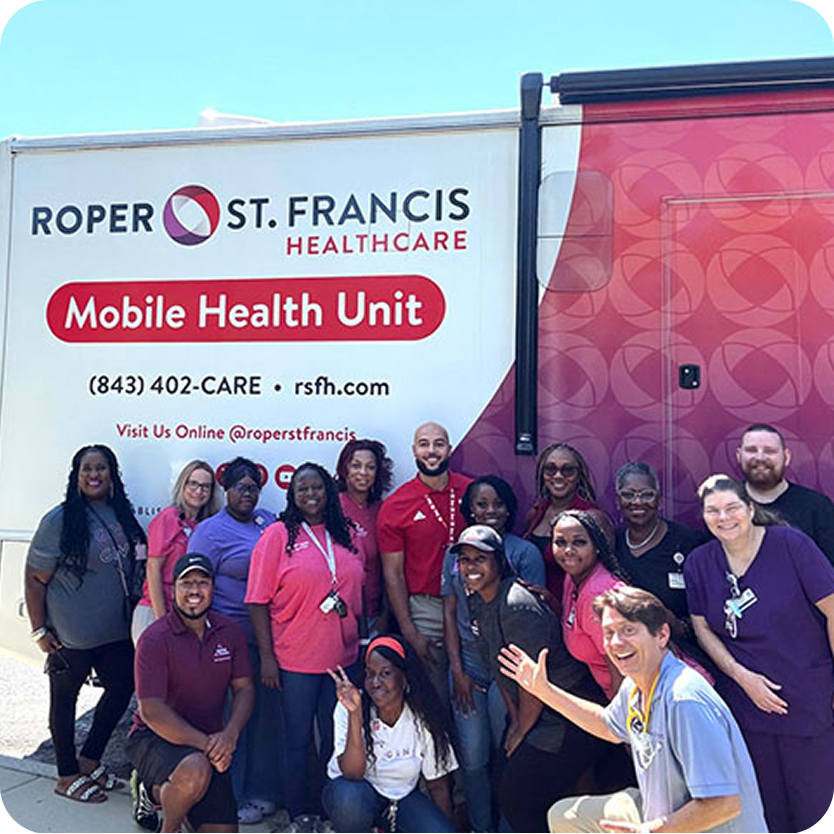
We are proud that our annual community benefit exceeds $50 million, but we prefer to measure it in smiles. Learn about all we do to give back.
Our future moving forward
We’re working on an ambitious strategic plan for the Lowcountry’s largest healthcare system for adults. Our goals include expanding our facilities, growing critical care areas, modernizing technology, becoming more sustainable and reducing the cost of care.