The decision to seek help for opioid use disorder isn’t always made during business hours. Sometimes it comes at 2 a.m. on a Saturday, when outpatient treatment centers are closed and a patient needs help now.
Dr. Kelli Young, an emergency medicine physician with Roper St. Francis Healthcare, wants to make sure that when that moment comes, the system’s emergency departments are equipped to respond.
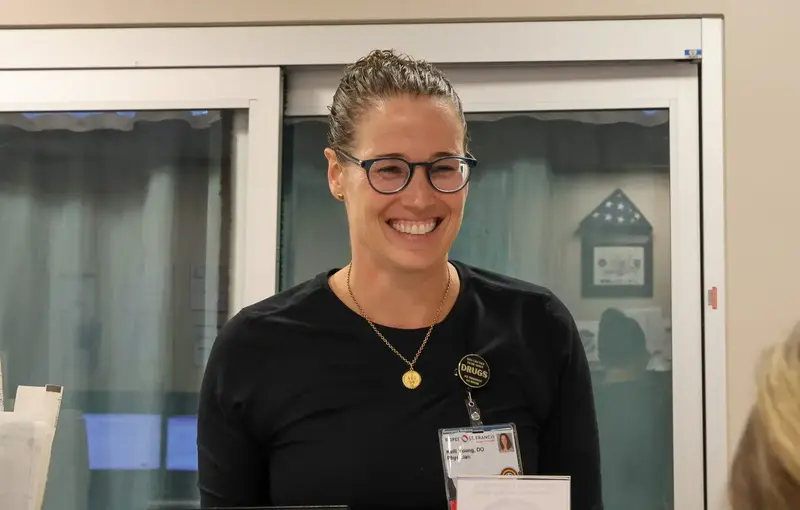
Dr. Young said, “the more you learn, the more you want to help,” in regards to improving access to care for patients with opioid use disorder.
Help for patients facing opioid use disorder
“If somebody hits the point where they are like, ‘I want help,’ we wanted to be able to give them that help when they need it,” Dr. Young said.
That goal has guided her work to expand access to treatment across Roper St. Francis Healthcare emergency departments. What began as a pilot project at Bon Secours St. Francis Hospital has grown into a collaborative effort involving physicians, advanced practice providers, case managers, Community Health and local opioid treatment centers.
Together, they are helping patients begin treatment when they’re ready and overcome barriers to ongoing care.
For one patient who repeatedly returned to the emergency department for buprenorphine, a medication used to treat opioid use disorder, the barrier was transportation. After reviewing his chart and talking with another provider, Dr. Young learned he couldn’t reach the treatment center where he had been referred. He could, however, get to the Greer Transitions Clinic.
Once connected with the clinic, he stopped returning to the emergency department for those prescriptions.
“If they’re still coming to the ED to get the buprenorphine, they don’t want to go back to active use,” Dr. Young said. “They want to be in treatment.”
Helping patients like him make that connection has become a driving force behind her work.
Support for when patients are ready
Around 2021, Dr. Young took the lead on a project to begin offering buprenorphine in the Bon Secours St. Francis Hospital emergency department.
The work included developing protocols for starting treatment, providing prescriptions to bridge patients to follow-up care and building relationships with local treatment providers, including Charleston Center and the Ernest E. Kennedy Center. Addiction Medicine physician Dr. Samuel Parrish’s work at the Greer Transitions Clinic created another connection for patients needing ongoing care.
The approach gave emergency teams a way to help patients begin treatment when they were ready, including overnight and on weekends. The program then expanded across all Roper St. Francis Healthcare emergency departments.
Along the way, Dr. Young has participated in education through California Bridge, an organization that helps hospitals establish and strengthen addiction treatment programs. Learning more about treatment and hearing how patients experienced the healthcare system deepened her commitment to the work.
“The more you learn, the more you want to do better,” she said.
Building connections beyond the Emergency Department 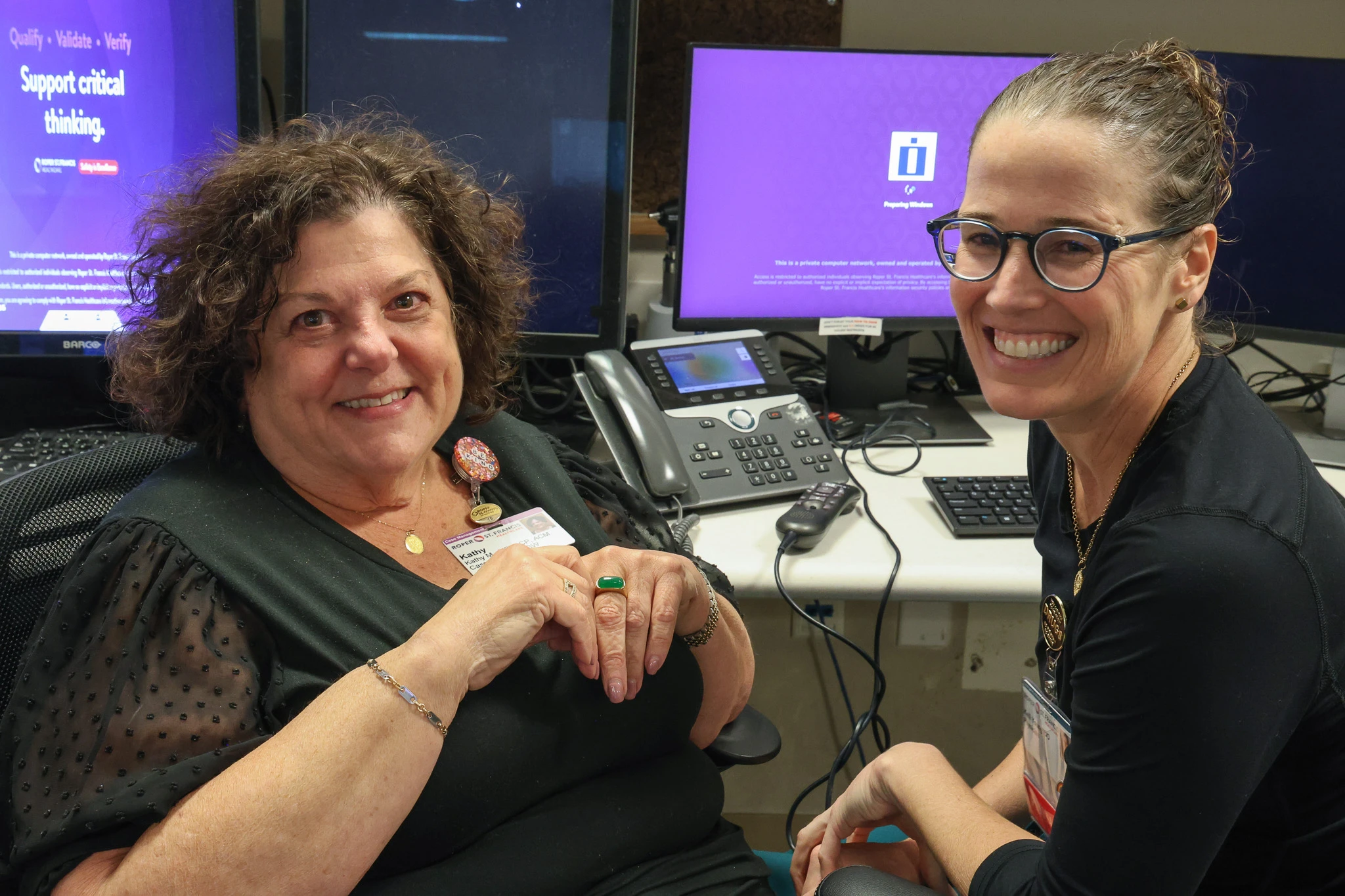
Dr. Young emphasizes the importance of collaborating across the system with Community Health, inpatient units and case managers like Kathy, pictured here, to encourage the best possible outcomes for patients.
Dr. Young also helped establish a substance use disorder committee, bringing together physicians from multiple specialties, advanced practice providers, case managers and administrators.
The group works to reduce stigma, educate teammates and strengthen connections with community partners. Its efforts include helping patients continue treatment as they move from the emergency department to an inpatient unit and, eventually, back into the community. Committee members have also worked with state agencies to make free take-home naloxone available in emergency departments.
Renee Linyard-Gary, associate vice president of Community Health, said Dr. Young’s willingness to bring people together helped move the work forward.
“Dr. Young has been a dedicated leader and a consistent voice for this effort,” Linyard-Gary said. “She brings people together around what we’re trying to accomplish for patients and inspires others to be a part of that work.”
Breaking down access barriers to care
The collaboration with Community Health has also brought a new source of support to the Bon Secours St. Francis Hospital emergency department. As part of a pilot program, patient navigator Tychia Brown meets patients in the ED and follows up with them after they leave.
Working alongside physicians, nurses and case managers, Brown helps patients connect with treatment and address barriers that may stand in the way. That might mean helping someone find a recovery program or reminding them which community agency to call when they’re ready to take the next step.
Emergency medicine clinicians can begin those conversations, Dr. Young said, but they are often caring for several patients with competing needs. Brown can spend more time helping patients figure out what comes next and give them a familiar person to turn to after their visit.
“Sometimes people have other needs that make it difficult to focus on treatment,” Linyard-Gary said. “They may need help getting medication, transportation or keeping the lights on. Having someone who can help them work through those barriers can make a difference.”
The pilot is partially funded through Bon Secours Mercy Health’s SEED grants, which support initiatives that address social determinants of health. Linyard-Gary and Dr. Young hope Brown’s role will help more patients connect with care and resources before a crisis brings them back to the emergency department. Linyard-Gary said the partnership brings clinical care and community resources together to help patients address needs that might otherwise make it difficult to pursue treatment.
-
 Treatments & Conditions An orthopedic surgeon's career of helping patients smile and move again
October 19, 2026 5 Minute Read
-
 Treatments & Conditions Roper St. Francis Healthcare launches Mobile Care for You unit to expand access across Lowcountry
October 1, 2026 5 Minute Read
-
 Treatments & Conditions After years of pain, spine surgery restores mobility
September 25, 2026 3 Minute Read
-
 Treatments & Conditions Roper St. Francis Healthcare first in state to offer promising new pancreatic cancer therapy
September 17, 2026
-
 Technology & Innovation Roper St. Francis Healthcare gets a new digital front door
September 1, 2026 2 Minute Read
-
 Healthy Living A primary care doctor’s best advice before your first visit
July 23, 2026 3 Minute Read
-
 Our Impact New Health Pavilion at Sawmill Centre expands emergency lab imaging services for Summerville
June 16, 2026
-

-

-

-
 Technology & Innovation Trailblazing cancer care: CAR T-cell therapy arrives at Roper St. Francis Healthcare
March 19, 2026
-
 Treatments & Conditions Epilepsy: What is it, how's it treated and why hope is a part of the plan
March 17, 2026 3 Minute Read
-
 Our Stories Gynecologic cancers: How brachytherapy afterloaders improve survival reduce side effects
March 12, 2026